A controlled content pipeline from search demand to site-ready publication
SEO Factory helps teams produce search and AI-ready articles without running the process through separate spreadsheets, prompt libraries, writers and publishing tools. We built the workspace around the full editorial lifecycle, not a single generation screen.
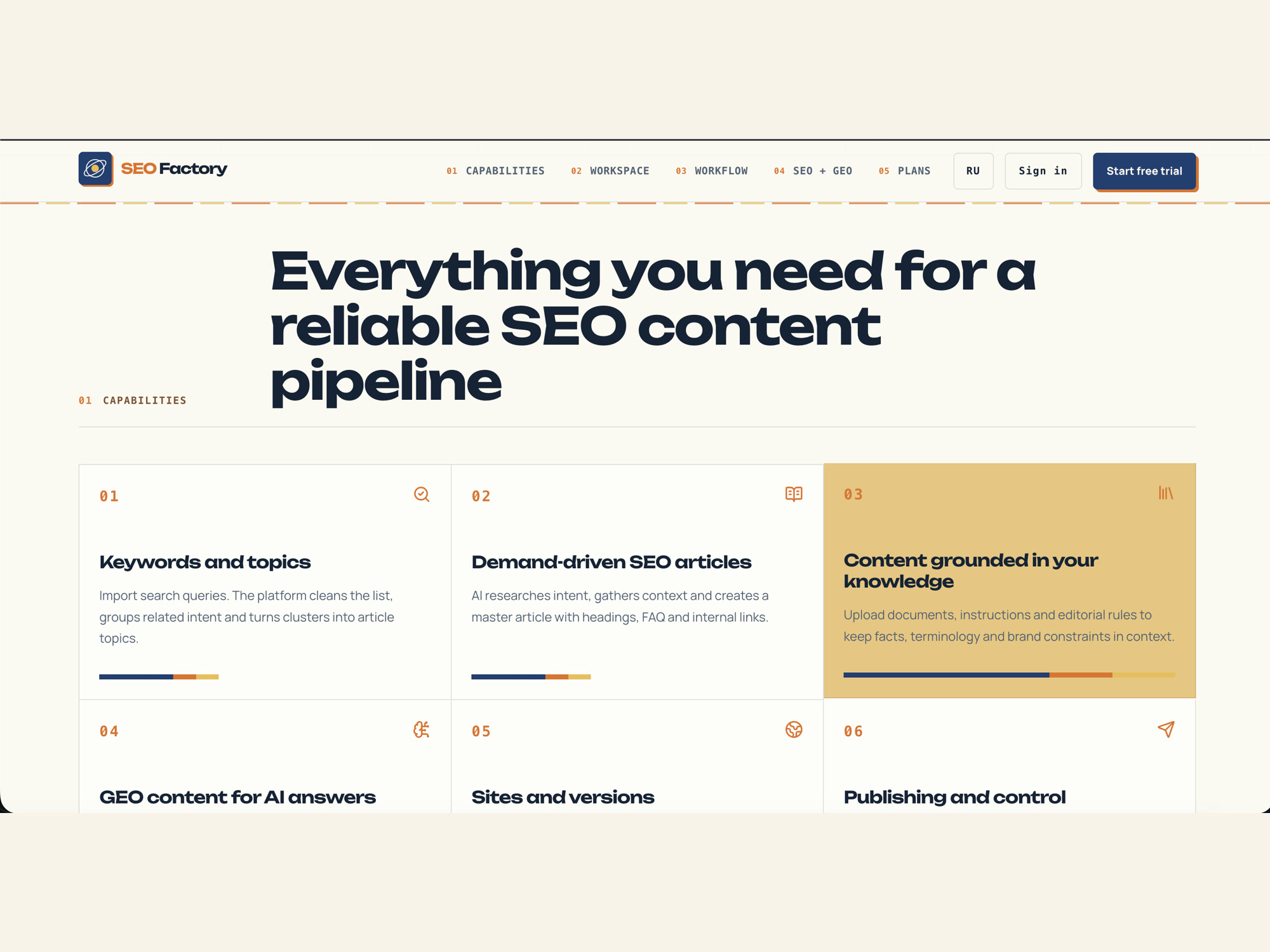
Content generation is only one stage of the system
Content automation is easy to start and difficult to control. A useful production system has to preserve company facts, follow real search demand, expose every article state, support editorial review and prepare different versions for different sites. Generation alone does not solve those operational requirements.
- Turned imported search queries into intent clusters and article topics instead of treating every keyword as a separate assignment.
- Added project context, documents and editorial rules so AI operations work with company-specific facts and terminology.
- Separated the master article from site versions, allowing one approved source to receive destination-specific links, CTA and local context.
- Kept human approval, revision requests, publishing state and AI operation history visible inside the same workspace.
One workspace for planning, editing and publishing
Semantic core import, cleanup, clustering and content planning
Knowledge base, article editor and review workflow
SEO, GEO and AEO-ready article structure with FAQ and links
Multi-site versions, protected RSS delivery and operation history
Long-running AI work stays outside the request cycle
The platform separates the product interface from the API and asynchronous content pipeline. PostgreSQL stores projects, topics, articles, versions, knowledge and editorial state. Redis coordinates background work, while workers and a scheduler run research, generation and publishing jobs outside the request cycle. Migrations and Docker configuration keep hosted and self-managed installations reproducible.
The result is an operational workspace where a team can see what should be written, which facts the system may use, where each article stands, how it changes for a destination site and when it is ready to publish. AI accelerates the repetitive stages; editors retain control over facts and release decisions.
Evidence boundary
- The platform supports SEO and GEO production but does not guarantee rankings, traffic or citations in AI answers.
- Generated material remains subject to human fact-checking, editorial approval and each destination site's technical quality.
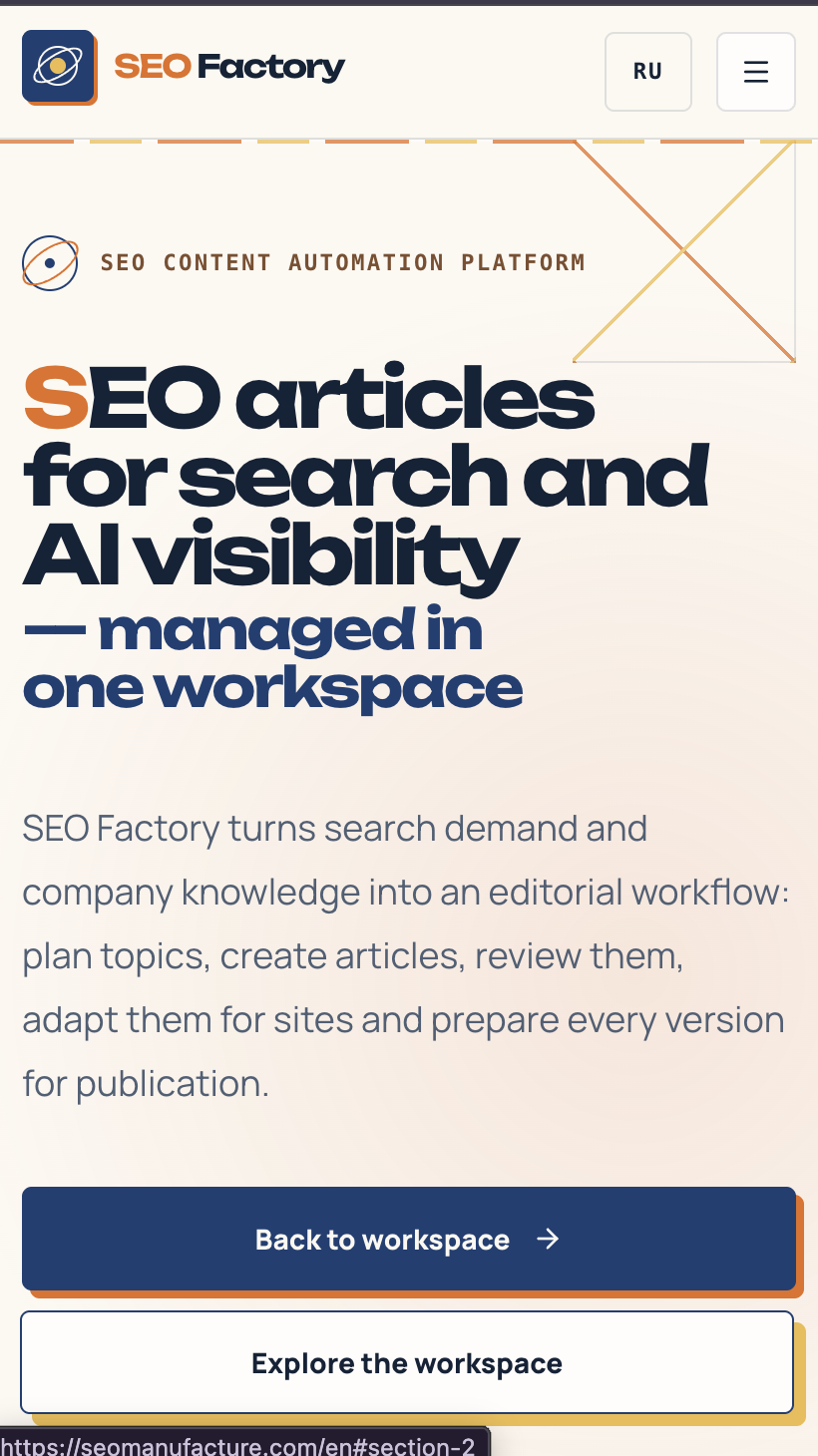
The workflow remains clear on a phone
The mobile surface preserves the primary product action, hierarchy and account context instead of reducing the page to a compressed desktop layout.
What buyers usually need to know
- What does SEO Factory automate?
- It automates query processing, topic planning, AI-assisted research and drafting, site-version preparation and RSS delivery while keeping review and approval visible to the team.
- How does the platform use company knowledge?
- Teams add documents, instructions and editorial rules to a project. These materials provide controlled context for research and drafting instead of relying only on a generic prompt.
- What is the difference between a master article and a site version?
- The master article is the approved source. Site versions adapt links, calls to action, URLs and optional local context for each publication destination.
- Does content publish without human approval?
- Only if the team configures that workflow. The standard product flow supports editing, revision requests and explicit approval before a version is delivered for publication.
Building an AI workflow that people still need to control?
We can structure the data, review states, background jobs and publishing integrations as one product system.