How ClaudeStore reached 248K Google impressions with an organic content system
ClaudeStore is an independent AI API platform with a documentation-led acquisition model. Lynto Labs optimized the public search and discovery architecture around technical buyer questions, integration intent and measurable conversion paths.
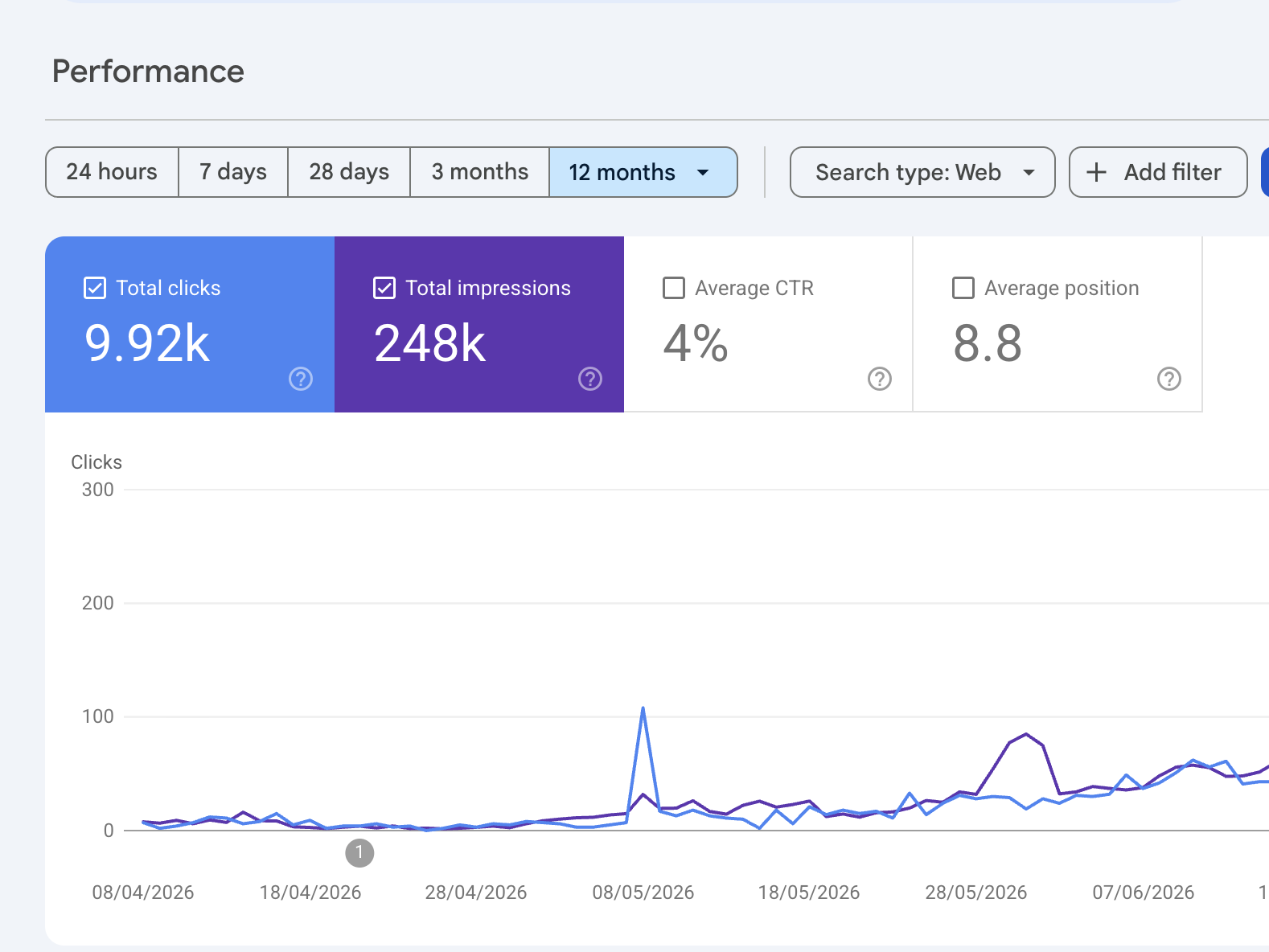
Google Search Console, Web Search, April 8-July 31, 2026. AI-referral share is calculated from first-party tracked sessions for the same period.
What the organic growth system needed to solve
The platform had to turn a large technical knowledge surface into a coherent acquisition channel. Search engines, AI assistants and developers needed to reach the same current facts without route duplication, hydration-only pages, stale model information or disconnected documentation.
- Mapped commercial and technical search intent into product, documentation, comparison and learning clusters.
- Aligned the client router, SSR renderer, prerender registry, canonical URLs, hreflang and sitemaps around one route source of truth.
- Reworked documentation around answer-first introductions, reproducible examples, FAQ coverage and explicit internal links.
- Added FAQ, HowTo and TechArticle structured data together with Markdown mirrors, llms.txt indexes and machine-readable discovery endpoints.
- Connected Search Console feedback with first-touch visit and signup attribution so organic and AI-referred demand could be evaluated separately.
The search and discovery layer
249 canonical public URLs across English, Russian, Chinese and Korean editions
Prerendered HTML with canonical, hreflang and sitemap parity
Answer-first documentation, schema and internal topic clusters
Markdown mirrors, llms.txt indexes, OpenAPI and knowledge graph discovery
First-party attribution for Google and AI-assistant referrals
How the acquisition system was organized
The growth system uses the route registry as the source of truth for runtime routing, prerendering, metadata, sitemaps and Markdown output. Product facts are reused across human pages, structured data and LLM-facing files, while private account and payment routes remain outside the indexable surface. Search and AI referrals are normalized into first-touch session and signup attribution without exposing customer data publicly.
Between April 8 and July 31, 2026, ClaudeStore generated 248K Google Search impressions and 9.92K organic clicks with a 4% CTR and an average position of 8.8. First-party attribution also identified AI assistants as the source of 5.1% of tracked sessions during the same period.
Measurement boundary
- Search Console metrics describe organic Google Web Search performance, not paid advertising.
- The 5.1% AI-referral share is based on first-party session attribution and does not claim that every AI citation exposes a referrer.
- Lynto Labs optimized the acquisition architecture and content system; this case does not claim that Lynto Labs built ClaudeStore's core product.
- The work improves crawlability, retrieval and conversion measurement but does not guarantee future rankings or AI citations.
What buyers usually need to know
- What did Lynto Labs optimize for ClaudeStore?
- Lynto Labs optimized the technical SEO, content architecture, multilingual discovery, structured data, Markdown and LLM discovery surfaces, internal linking and first-touch attribution. The engagement focused on organic acquisition rather than core product development.
- Were the reported clicks generated by paid advertising?
- No. The reported 248K impressions and 9.92K clicks are Google Search Console Web Search metrics, which represent organic Google visibility and clicks.
- How did GEO and AEO fit into the work?
- The same current product facts were made available through answer-first pages, structured data, Markdown mirrors, llms.txt indexes, OpenAPI and knowledge graph endpoints. This improves machine retrieval without replacing conventional technical SEO.
- Can this approach be applied to an existing SaaS product?
- Yes. The first stage can audit route and canonical consistency, search intent coverage, documentation quality, structured data, internal links and attribution before new pages are added.
- Does this type of work guarantee rankings?
- No. Lynto Labs can remove technical blockers, improve information architecture and build a measurable organic acquisition system, but rankings and AI citations remain controlled by external platforms.
Need organic growth or a technical product built around real demand?
Choose the relevant path and send the current product, market and acquisition context. We will define a focused first scope.